
How to plan a shared kiln load
Five steps that fill your kiln, keep members happy and stop the Friday-night shelf scramble.
On this page2 sections
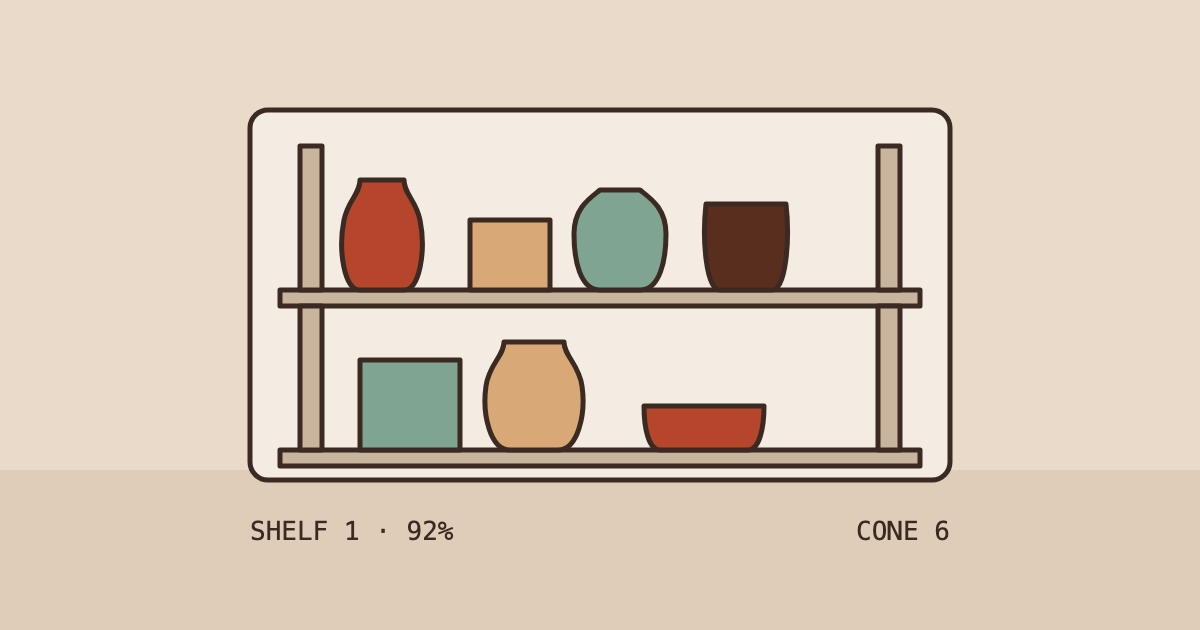
A community studio lives and dies by its kiln schedule. Half-empty bisque loads waste power. Overfull glaze loads mean someone’s mug waits another week. This is the process we use at our own studio in Porto.
The process
Set a cutoff
Pieces on the ready shelf by Wednesday 18:00 go in the weekend firing. Anything later waits. Post the cutoff where people drop work.
Log every piece
Members tag each piece with their name, clay body and glaze. In Kilnworks, scan the shelf tag and the piece joins the next firing queue.
Group by cone
Never mix cone 6 and cone 10 work. Kilnworks splits the queue by target cone and shows how many shelves each group needs.
Load tall pieces first
Plan shelf heights around the tallest work, then fill gaps with tiles and small cups.
Close the loop
After unloading, mark the firing done. Members get a message that their work is ready, with a photo of the shelf if you take one.
Firing fees
Charging per shelf is simple, but it punishes small pieces. Charging by volume is fair, but slow to measure. We charge by footprint: length times width of the base, rounded up to the next 5 cm². Kilnworks calculates it from the dimensions on the shelf tag.